


The Archimedes Models
Join thousands who've already started their Forest School journey
The Archimedes Models
Ten ways of seeing a child.
Every model here began as an observation in a wood, not a theory in a room. Together they are what an Archimedes practitioner is trained to notice.
Why there are ten
One framework flattens a child into a single measure. Ten hold them whole. Each model looks at a different part of what is happening when a child is free to explore, and each one comes with an observation tool so what you notice can be recorded, revisited and evidenced.
The models
Model 01
The Blackwell Growth Cycle
Belief ignites. Inspiration, aspiration, transformation.
Six stages, in order, that turn. Miss one and the next cannot hold. The cycle runs in a single moment, across a day, through a term and across a whole life, and it runs the same way for the child and for the adult learning to work with them.
- Biology
- Boundary
- Belonging
- Belief
- Build
- Brilliance
Where it is taught. Introduced at Level 1, worked at Level 2, held as the ground of practice at Level 3, and assessed in other people's work at Level 4.
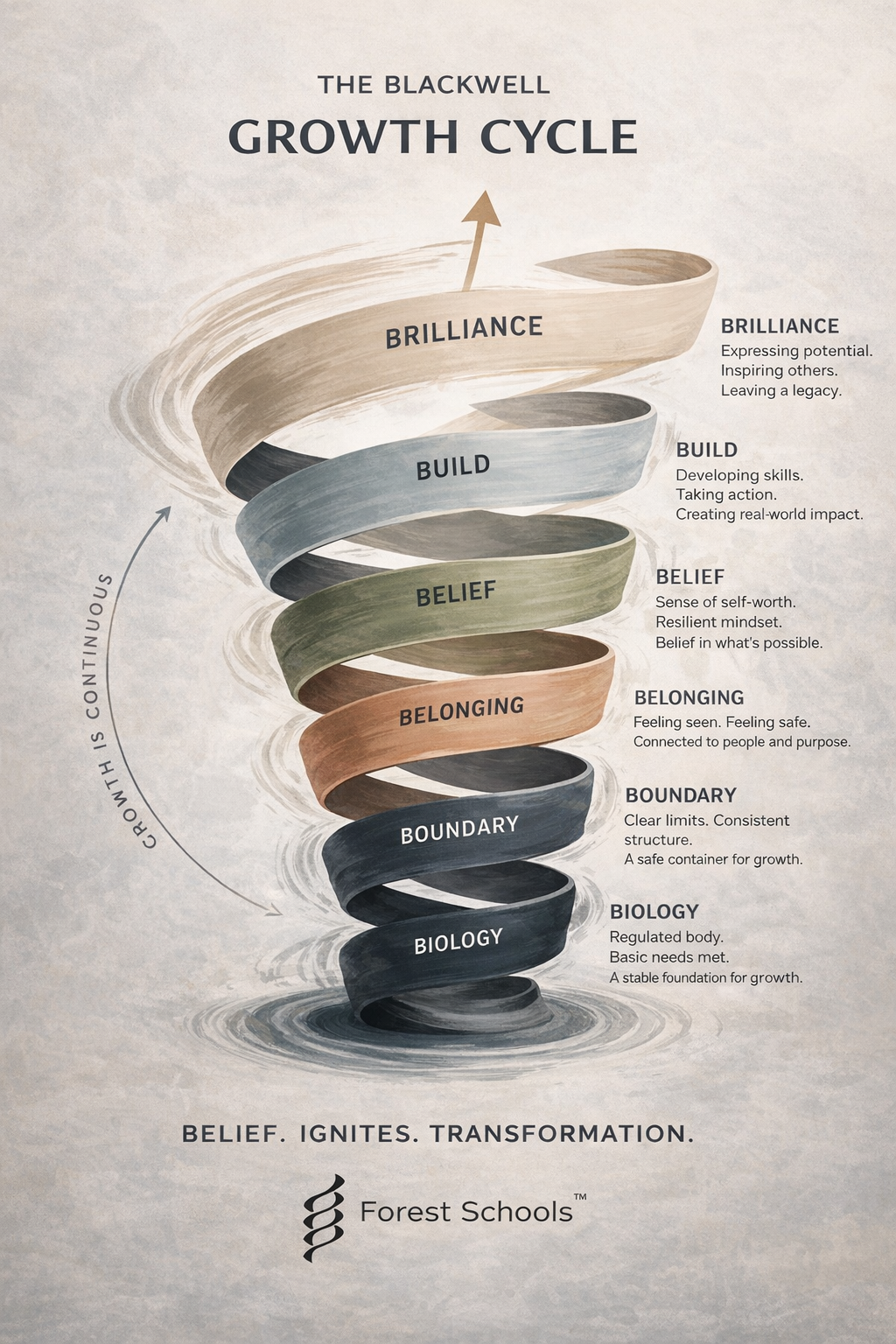
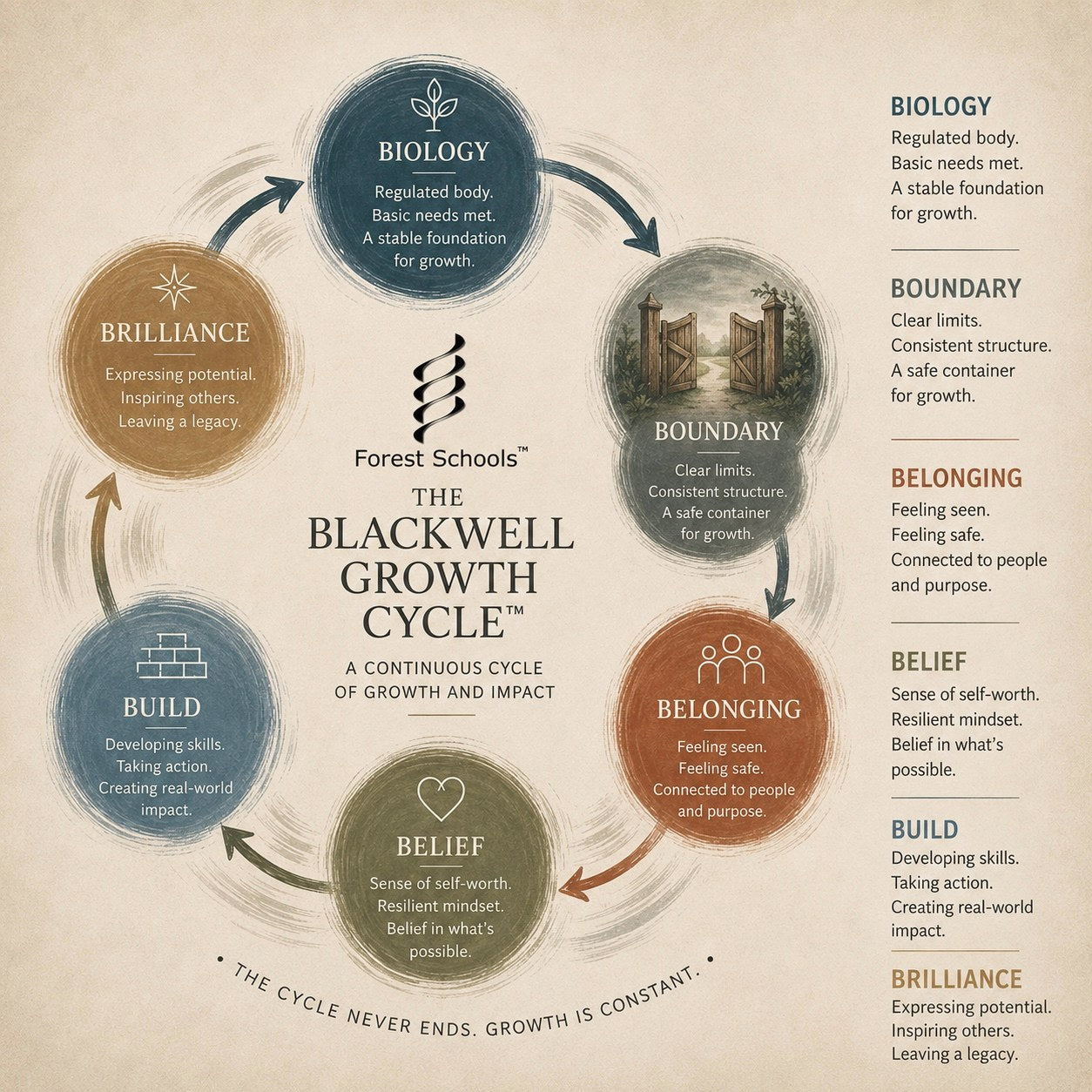
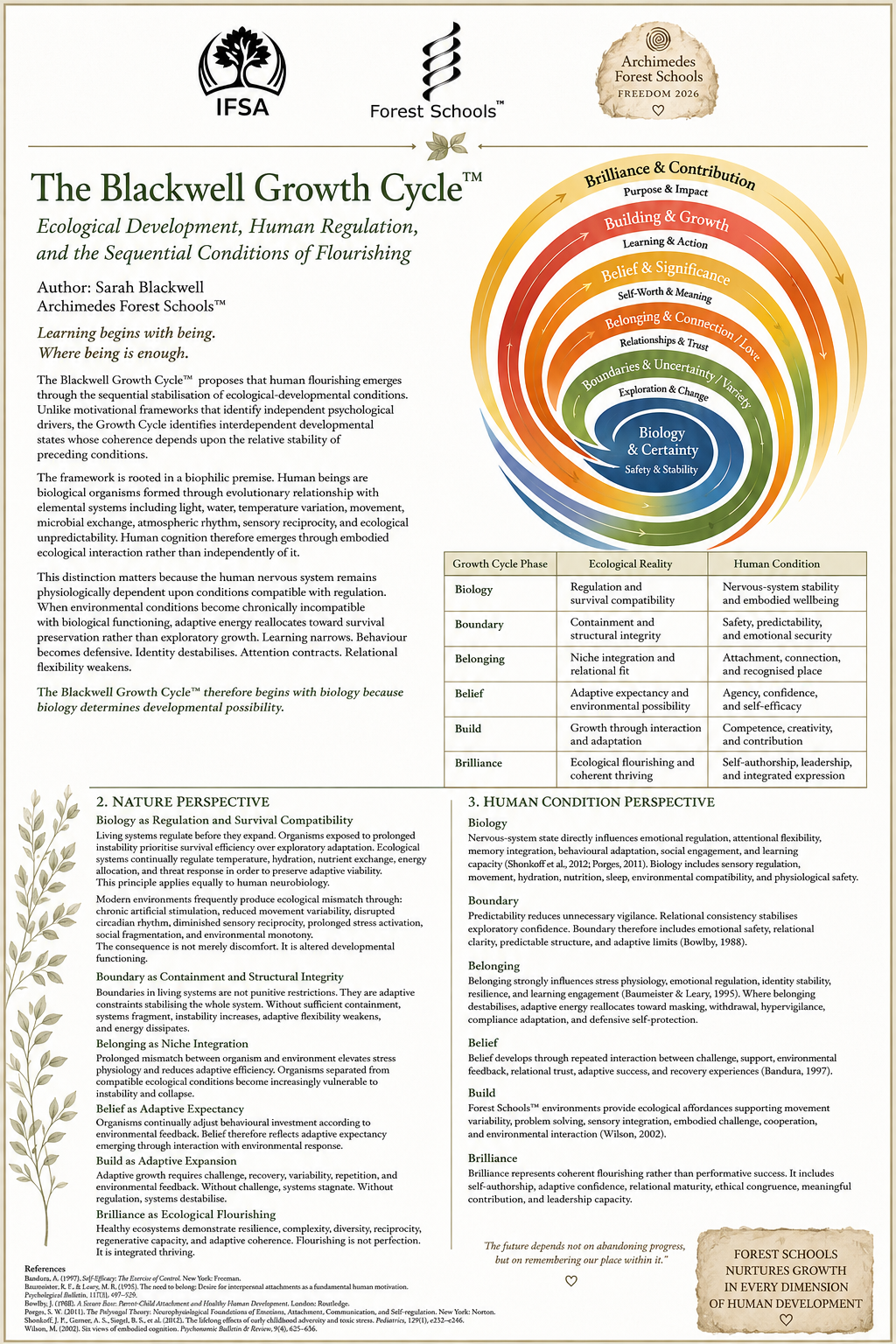
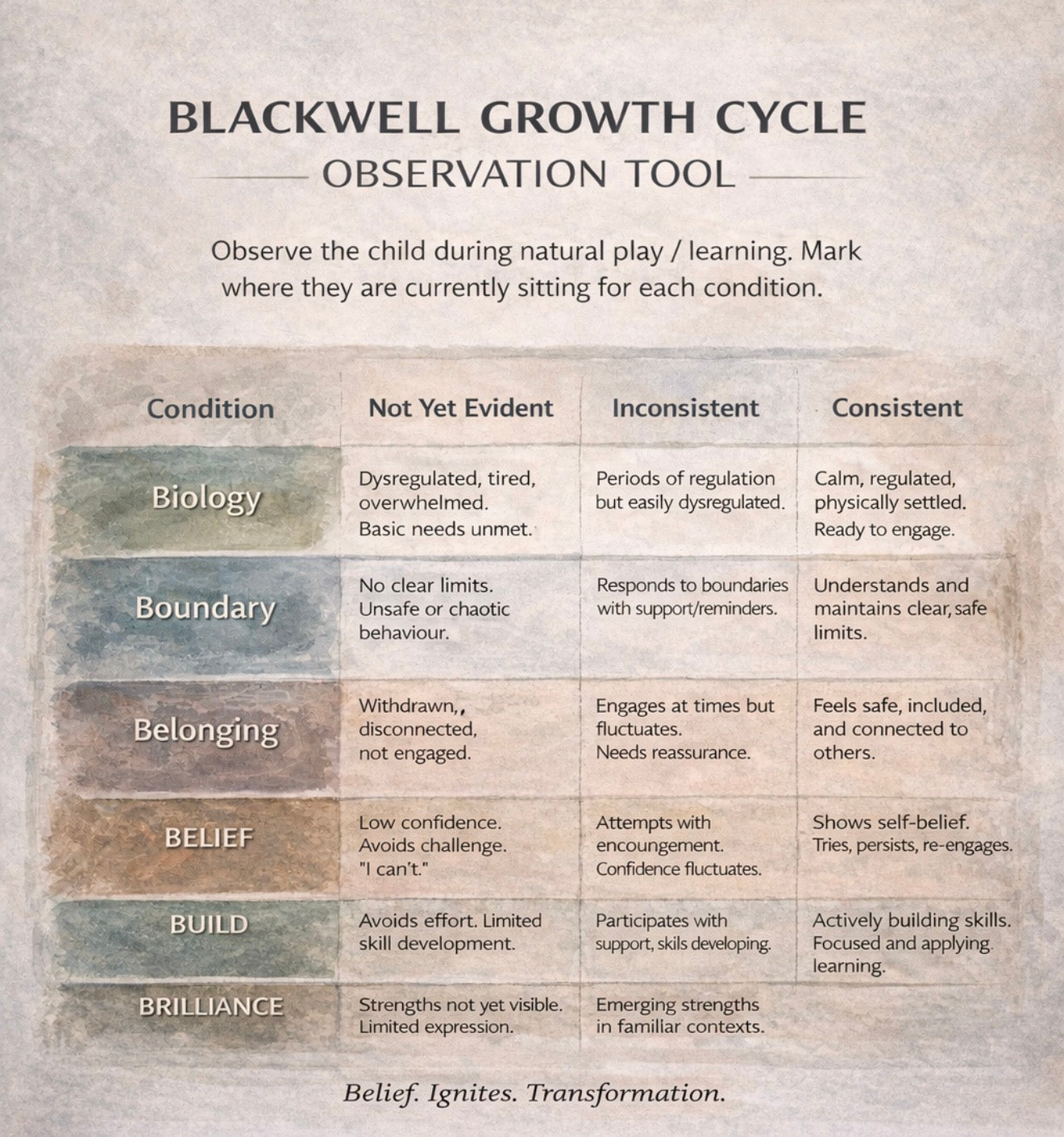
The cycle as a rising spiral, as a closed circle, and set out as a paper. Then the observation tool practitioners use in session.
In a moment · In a day · Across a term · Across a life
The same six stages, walked by the learner
The clearest way to understand the cycle is to notice that you go through it yourself while you train. This is what the six stages look like for an adult coming to Archimedes.
- Stage 01BiologyBiophilic needs met first. Warm, fed, safe, outdoors. Nobody begins learning before the body has settled.
- Stage 02BoundaryWhat it means to work as an Archimedes practitioner. Tool talks. Sawing and fire done correctly. Risk assessment, session planning, and the observations that make each session belong to the children in front of you.
- Stage 03BelongingFeeling part of a movement rather than alone with an idea. A peer group, and twenty five thousand others who have walked the same road.
- Stage 04BeliefBelieving this is a journey, and that you will come out of it a different person with different thinking and different goals.
- Stage 05BuildThe portfolio, and the sessions themselves. Not teaching, but putting out what meets the child's own catalyst, their intrinsic motivation, and then getting out of the way.
- Stage 06BrillianceThe qualification passed and the practice shining, precisely because every stage beneath it was taken and none was skipped.
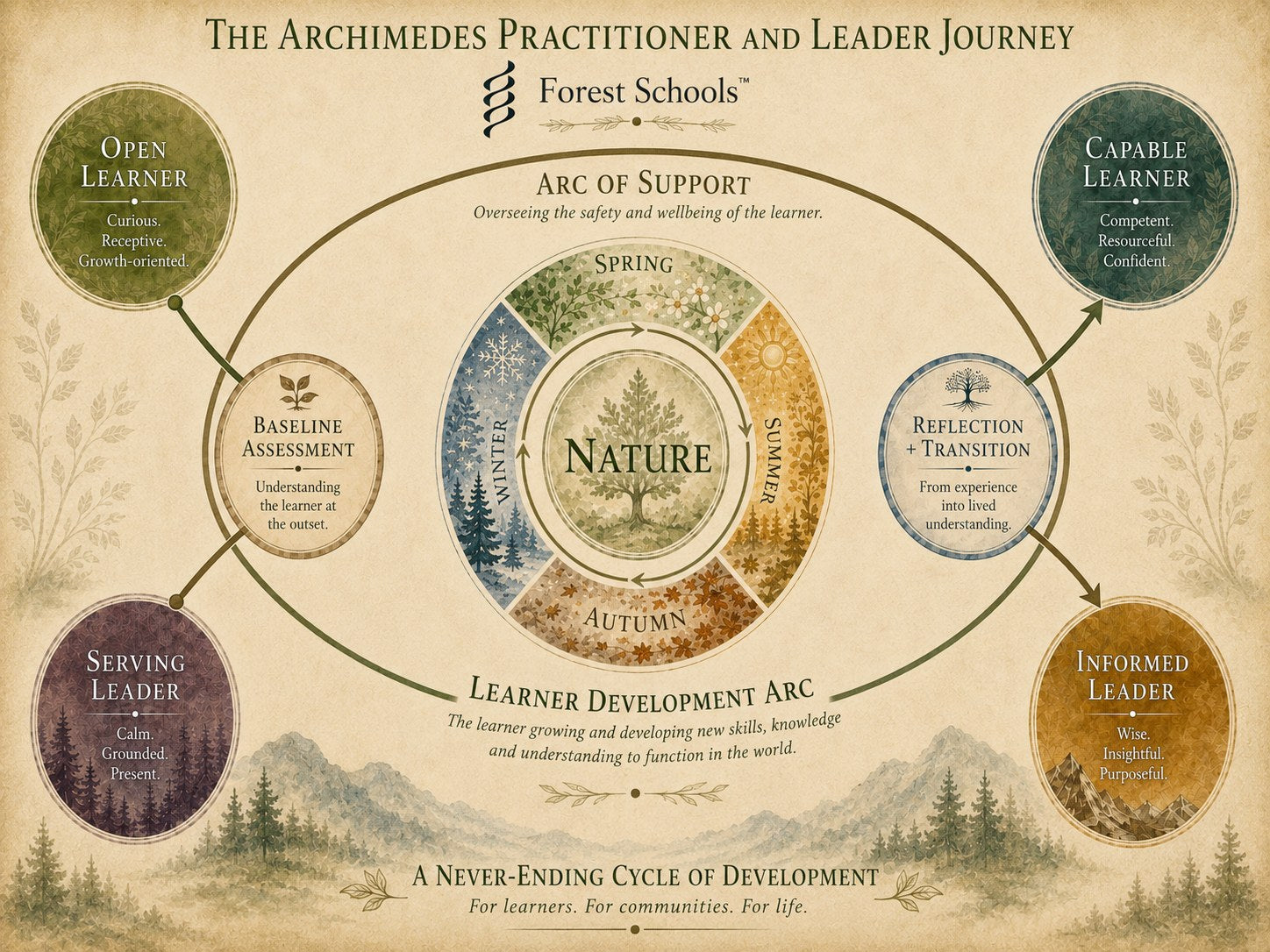
The same journey drawn out. The learner travels the lower arc from open to capable; the leader holds the upper arc of support, and travels their own from serving to informed. Nature and the turning seasons sit at the centre of both.
And then it begins again. Alone in your own setting, setting your own targets, a fresh loop every day and a longer one every year. Succeed and you do it brilliantly, and the cycle turns once more. It is exactly the same for the children.
Model 02
The CHOCOLATE Box Schema
Small things, big discoveries.
Nine repeating patterns of play through which a child meets the physical world and builds an internal picture of how it works. Without those encounters, imagination has nothing to be made of.
- Circular
- Height
- Over & Under
- Cover
- Own & Fill
- Level
- Attach
- Transport
- Edging
Where it is taught. Level 2 as recognition in the moment, Level 3 as planning and provision, Level 4 as the standard for judging another practitioner's environment.
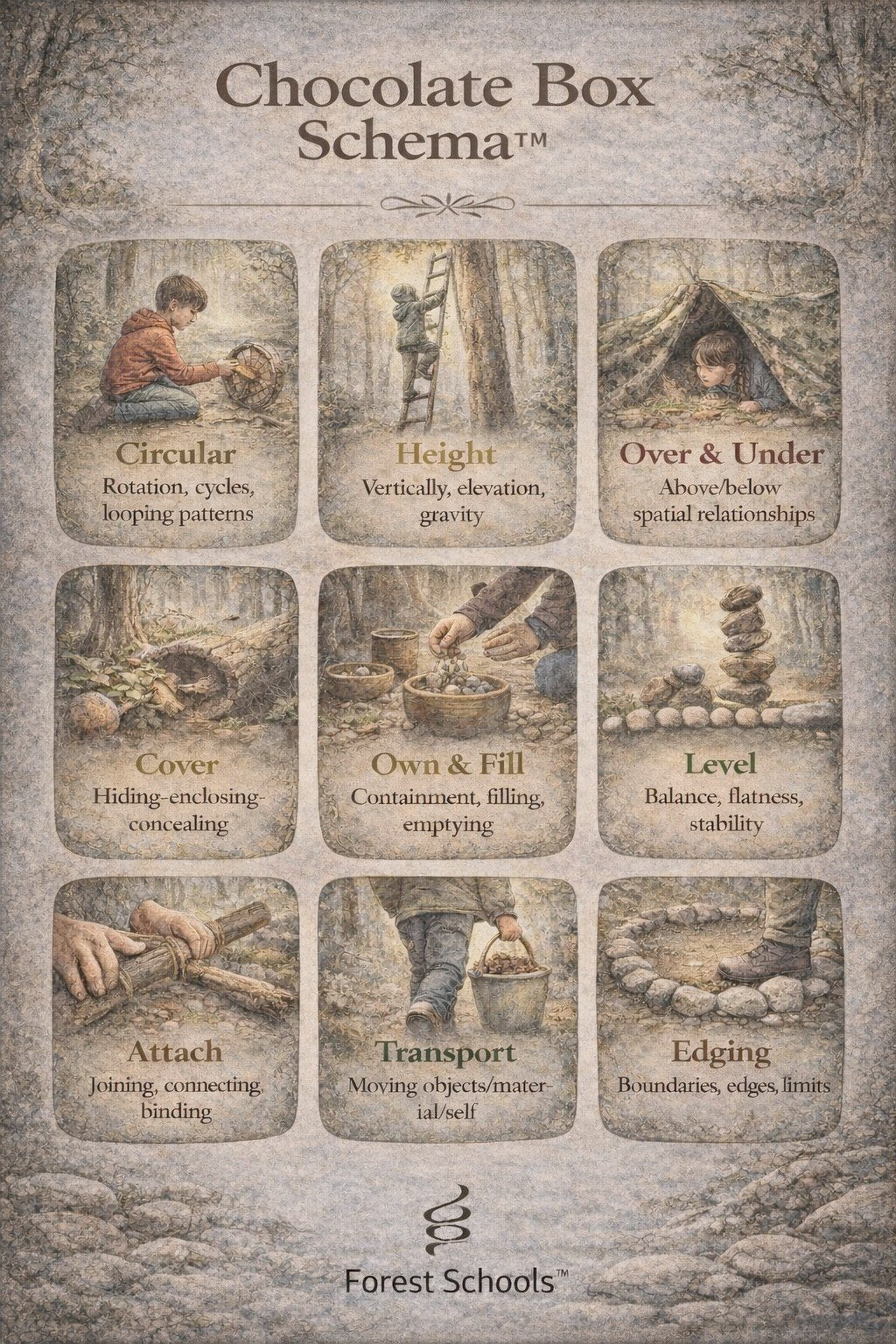
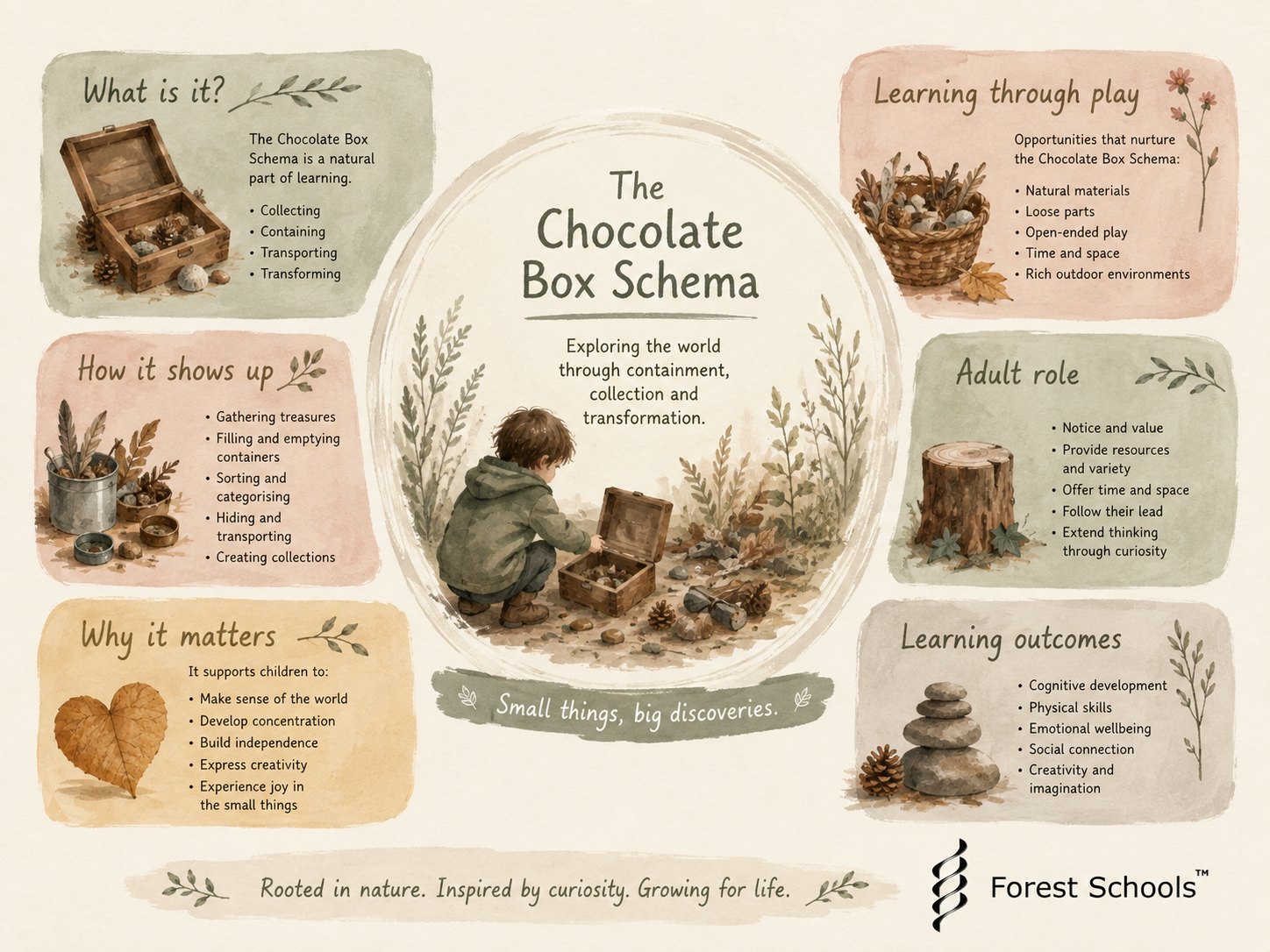
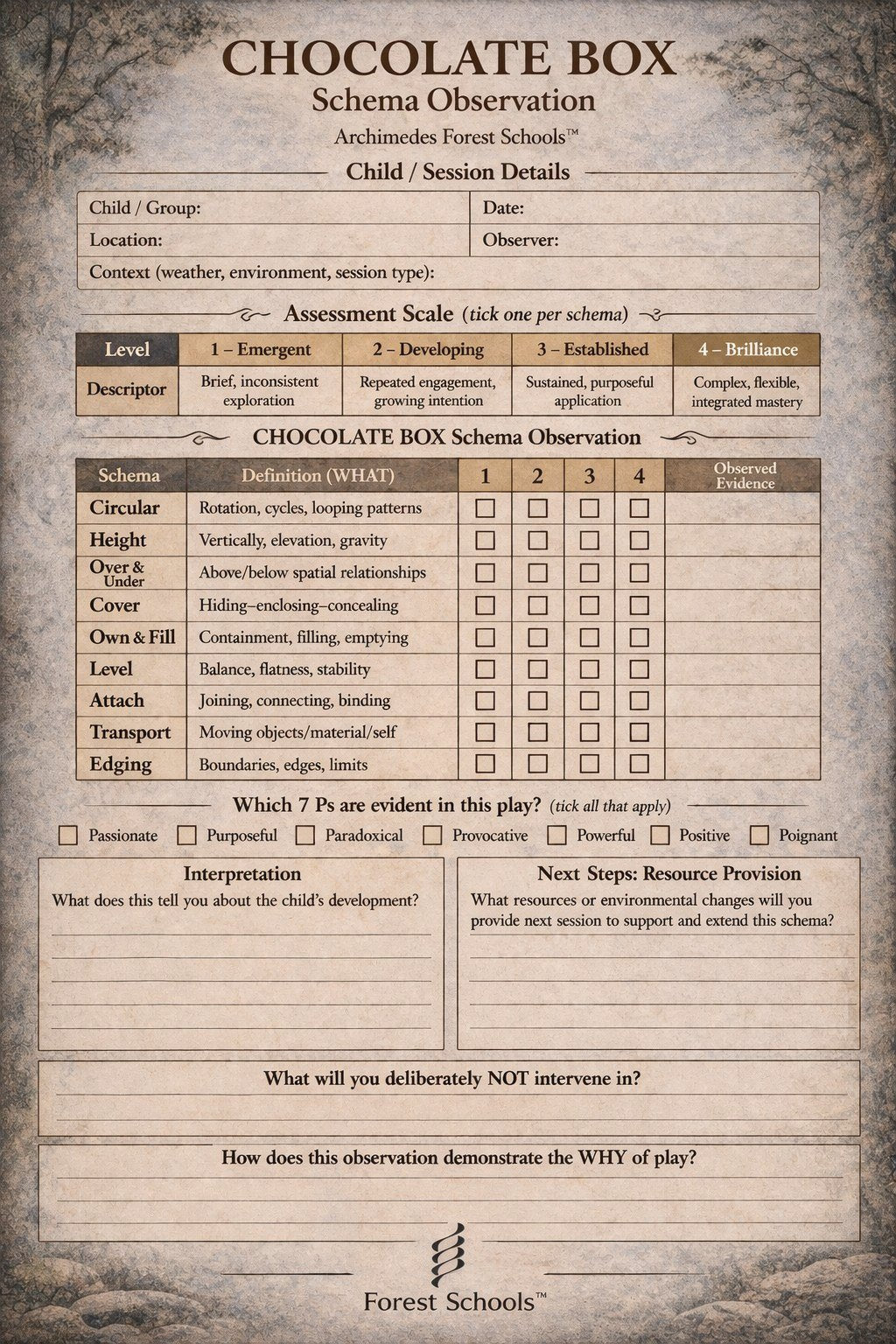
The nine schemas, the practitioner summary, and the observation tool.
Model 03
The 7 P's of Play
Not what the child is doing. Why it counts.
Seven qualities that tell you whether play is doing real developmental work. They are how a practitioner answers the hardest question an inspector asks: why did you let that continue?
- Passionate
- Purposeful
- Paradoxical
- Provocative
- Powerful
- Positive
- Poignant
Where it is taught. Level 2 as language for what you are seeing, Level 3 as the justification for intervening or deliberately not intervening.
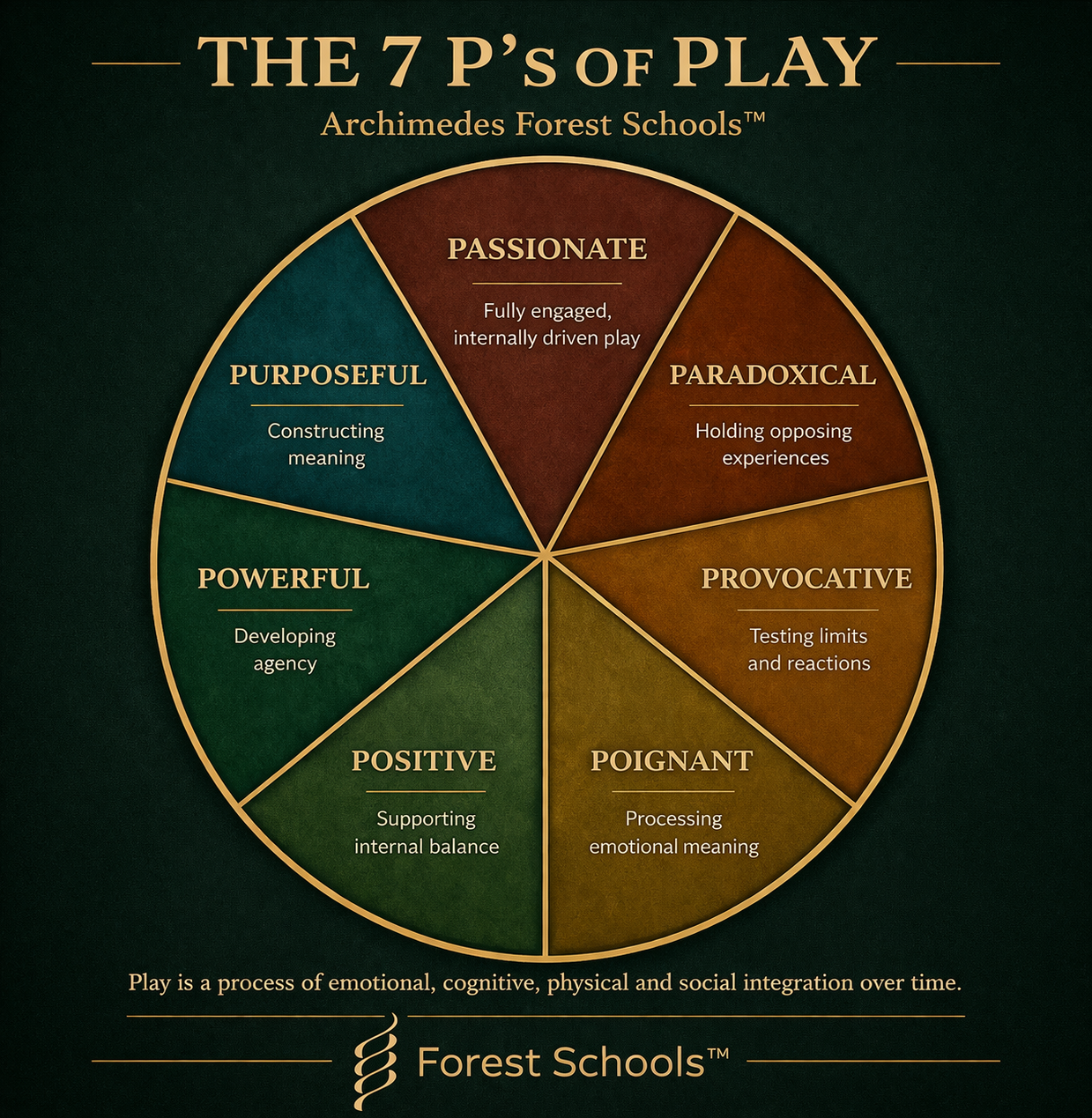
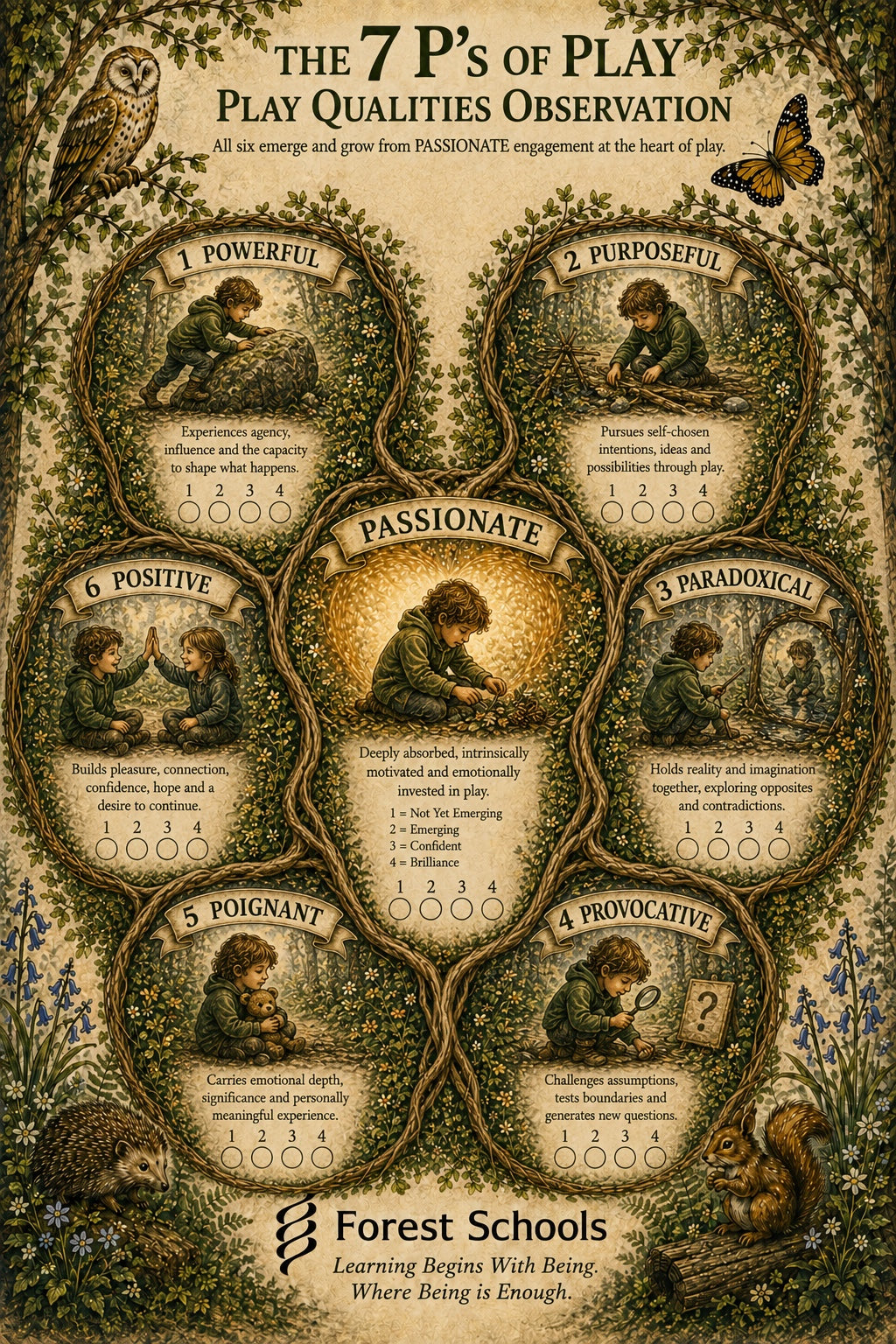
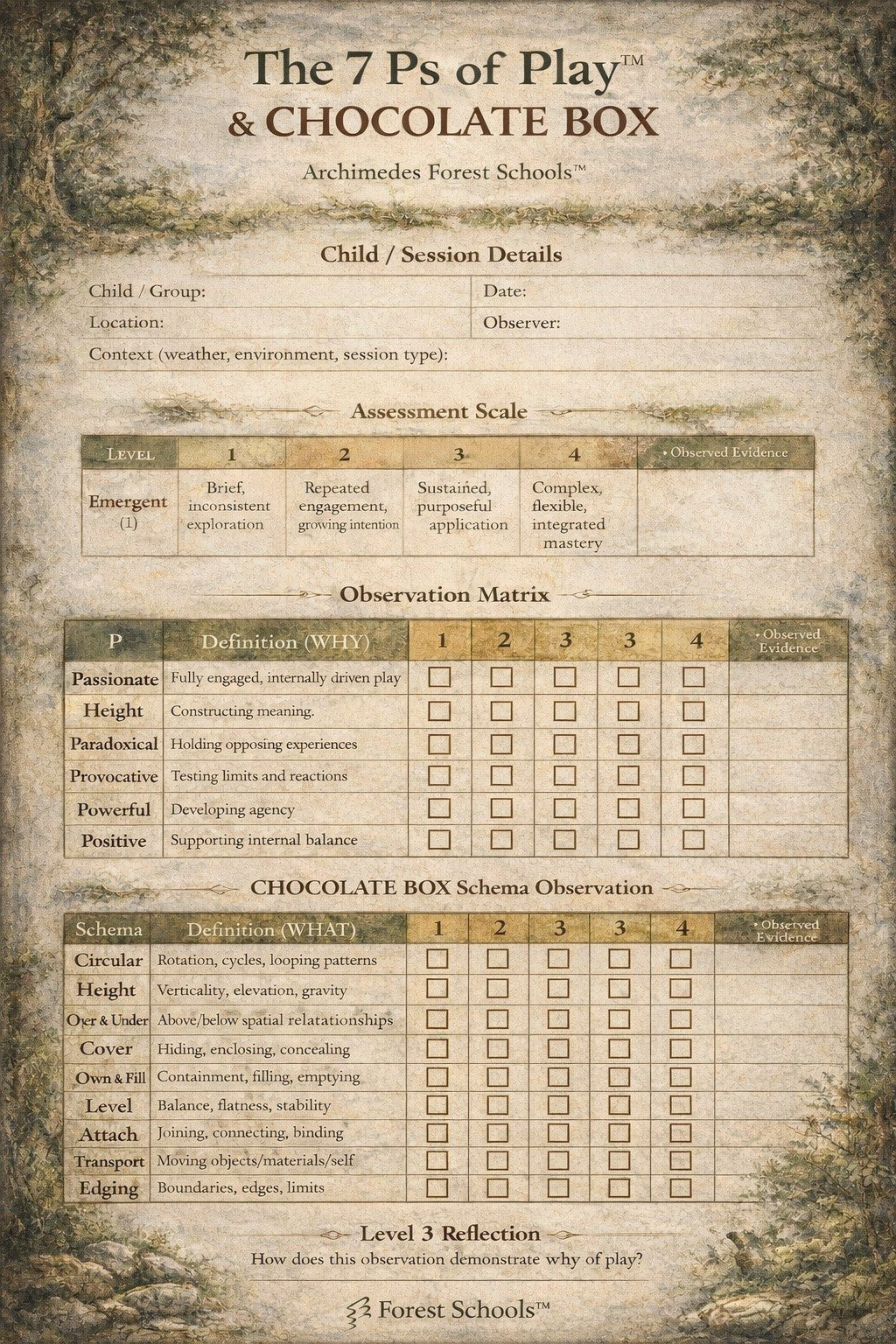
The wheel, the qualities in full, and the combined observation matrix that pairs the P's with the schemas.
Model 04
The 5 C's Emotional Wealth Inventory
Emotional wealth grows when a child is seen, heard, held and able to flourish.
Three C's the child carries inside and two the community gives back. Together they describe whether a child has enough emotional resource to take on anything else.
- Consciousness
- Control
- Catalyst
- Compassion
- Community & Companionship
Where it is taught. Level 2 as awareness of the child in front of you, Level 3 as a recorded inventory reviewed across a term.
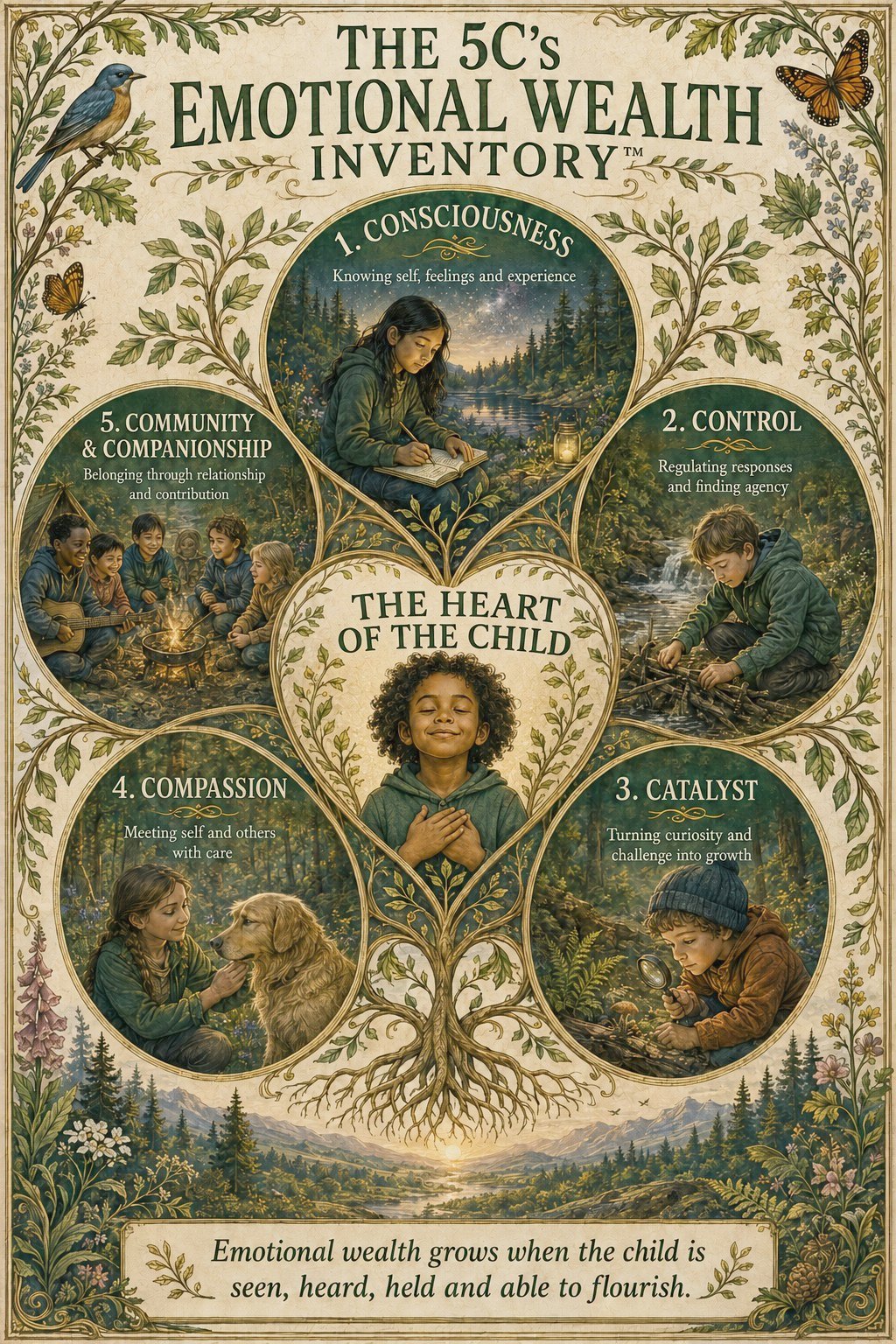
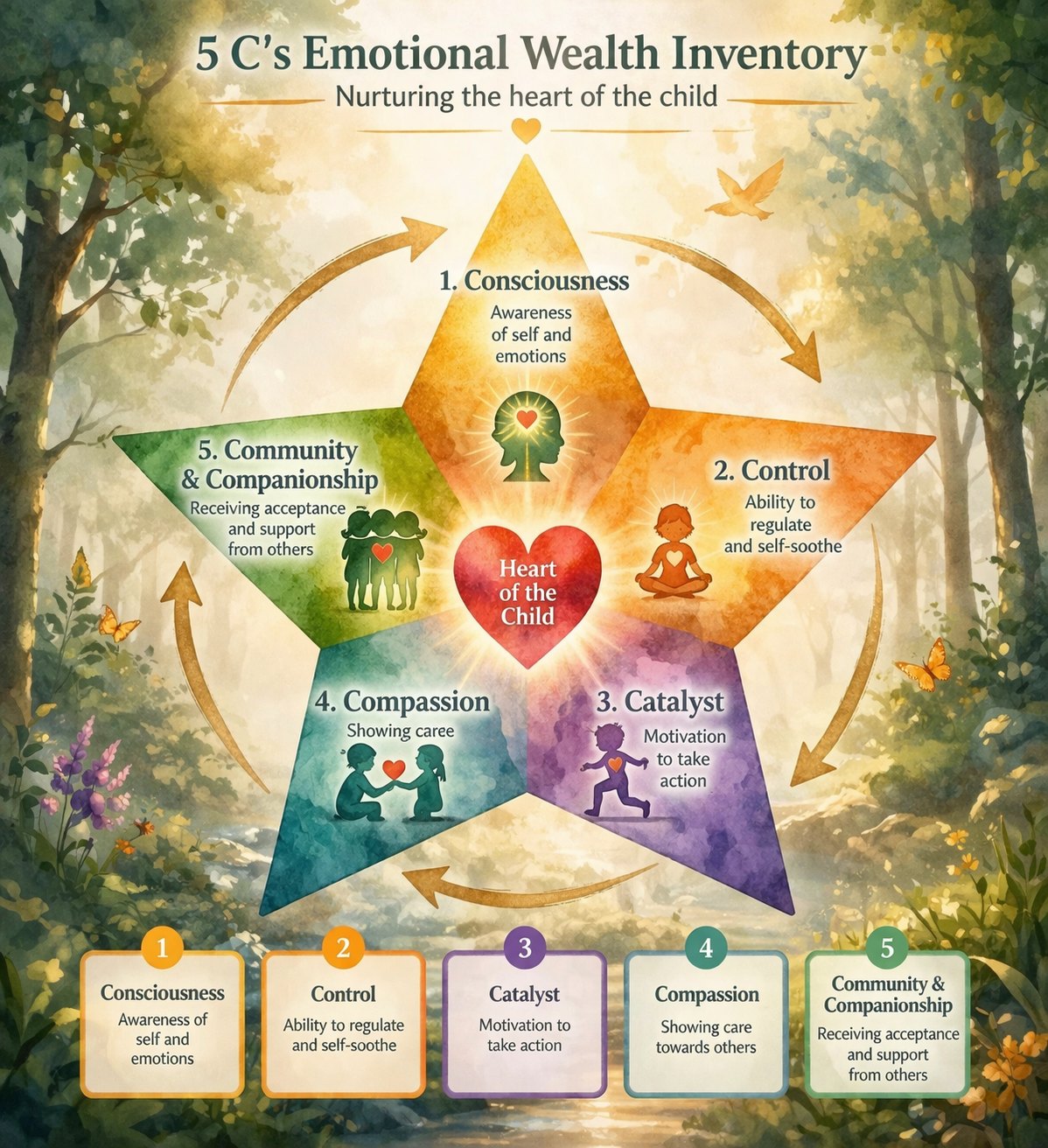
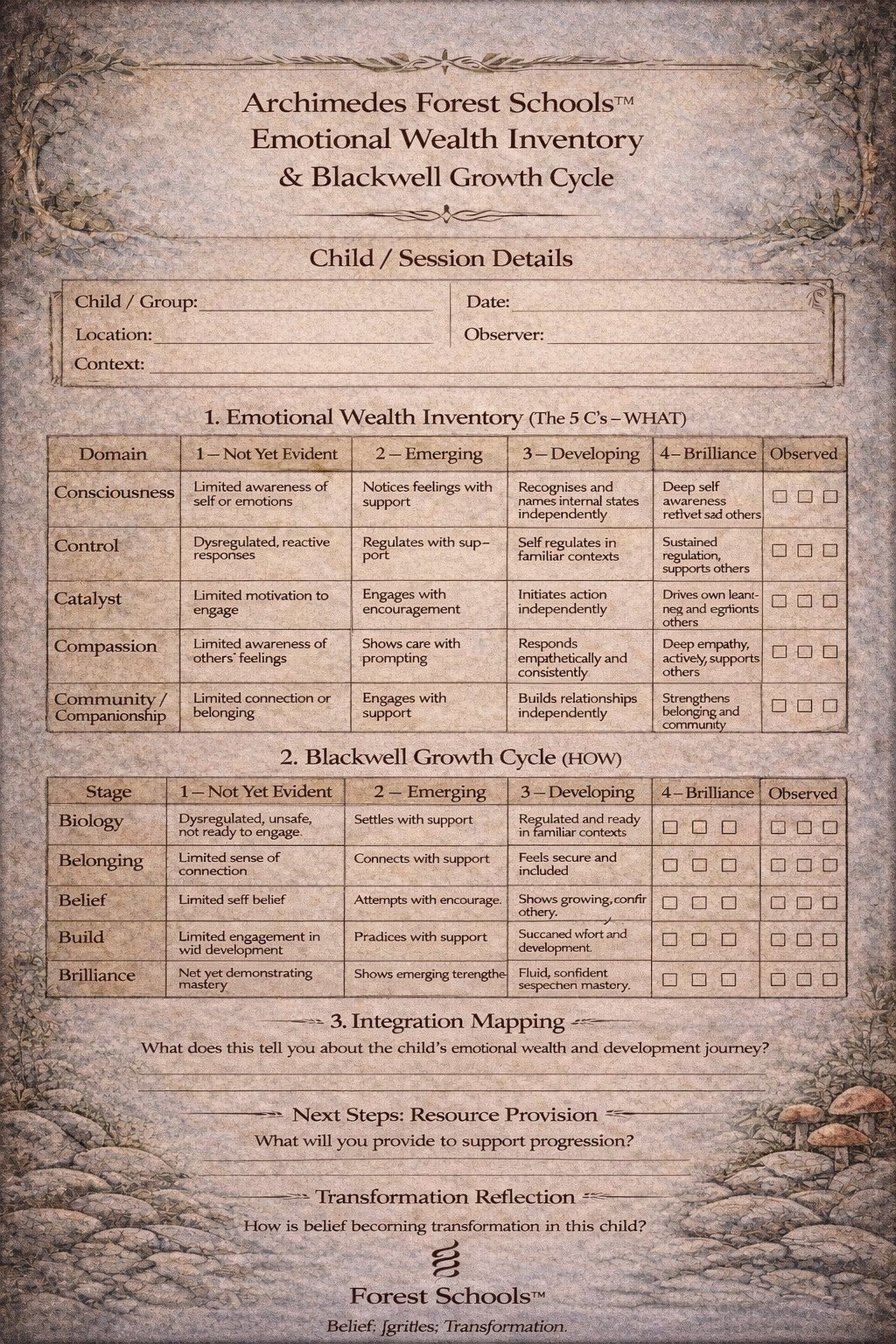
The inventory, the star, and the form that maps emotional wealth against the Growth Cycle.
Model 05
The Seven R Characteristics
The characteristics a person needs to function as a capable learner, and to take part in as many social situations as they choose, at any age.
Not skills for a school year. Characteristics for a lifetime, independent of chronological or maturational age. Every one of them grows through the same capability at the centre: reflection.
- Respect
- Responsibility
- Resilience
- Risk Management
- Relationships
- Resourcefulness
- Reasoning
Where it is taught. Level 3 as the long view of a child's development, observed longitudinally rather than tested. Level 4 as the outcome a whole setting is accountable for.
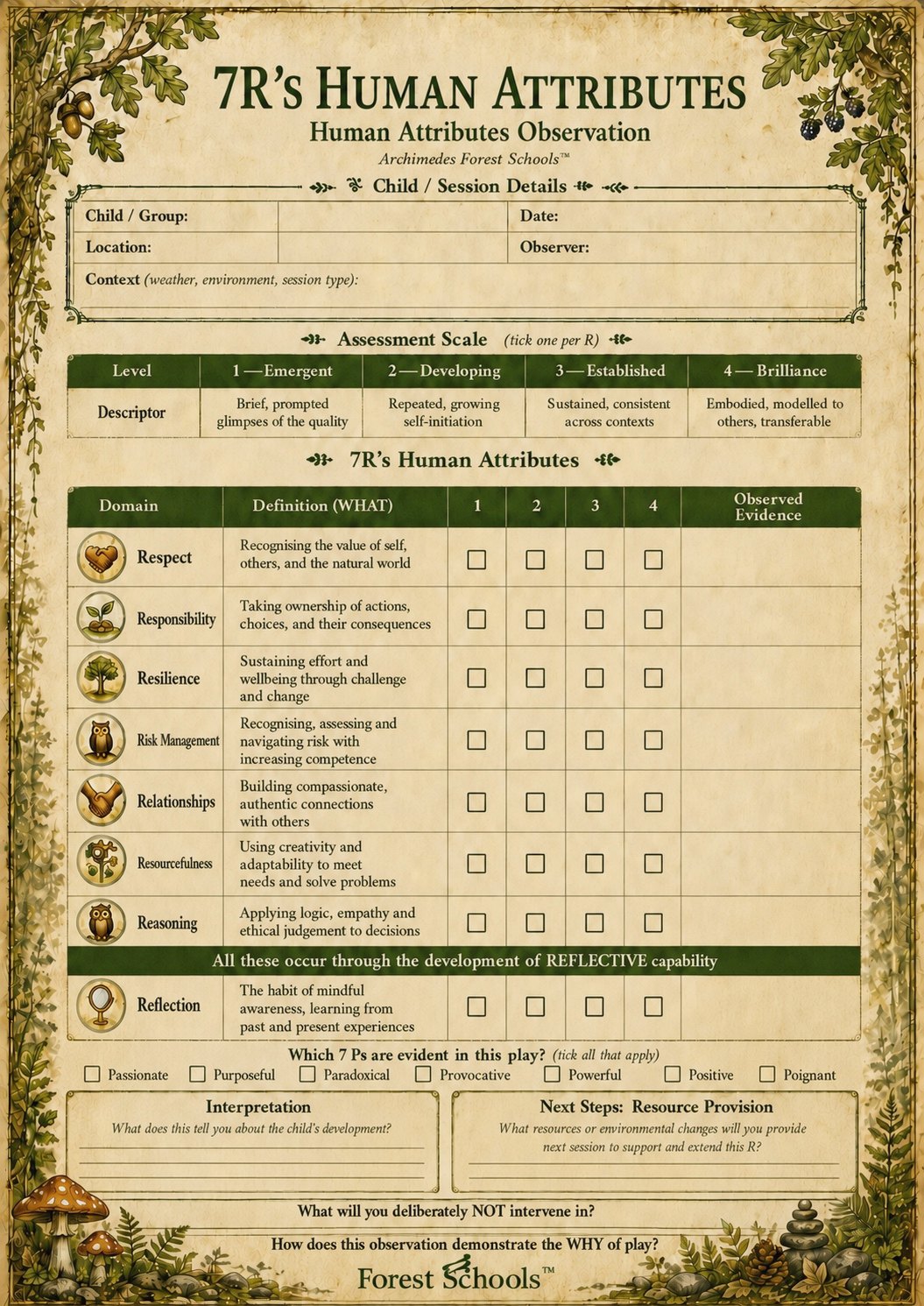
The seven characteristics, reflection at the centre, and the observation tool.
Model 06
Community of Brilliance: the Intelligences
Every child is clever. Not every child is clever in the same way.
Nine intelligences, spelling COMMUNITY, ending in Innovation, Transcendence and Yarn, which is storytelling, words and language. A rounded child holds a token of each and is markedly stronger in one or two.
Built on Howard Gardner's multiple intelligences and extended by twenty five years of watching what actually happens when children are outdoors. Not categories in a textbook. Living, observable processes.
- Concepts
- Others
- Music
- Movement
- Unique Self
- Nature
- Innovation
- Transcendence
- Yarn
Where it is taught. Level 3 across a six week baseline, then every six weeks. Level 4 as the model a trainer teaches and moderates.
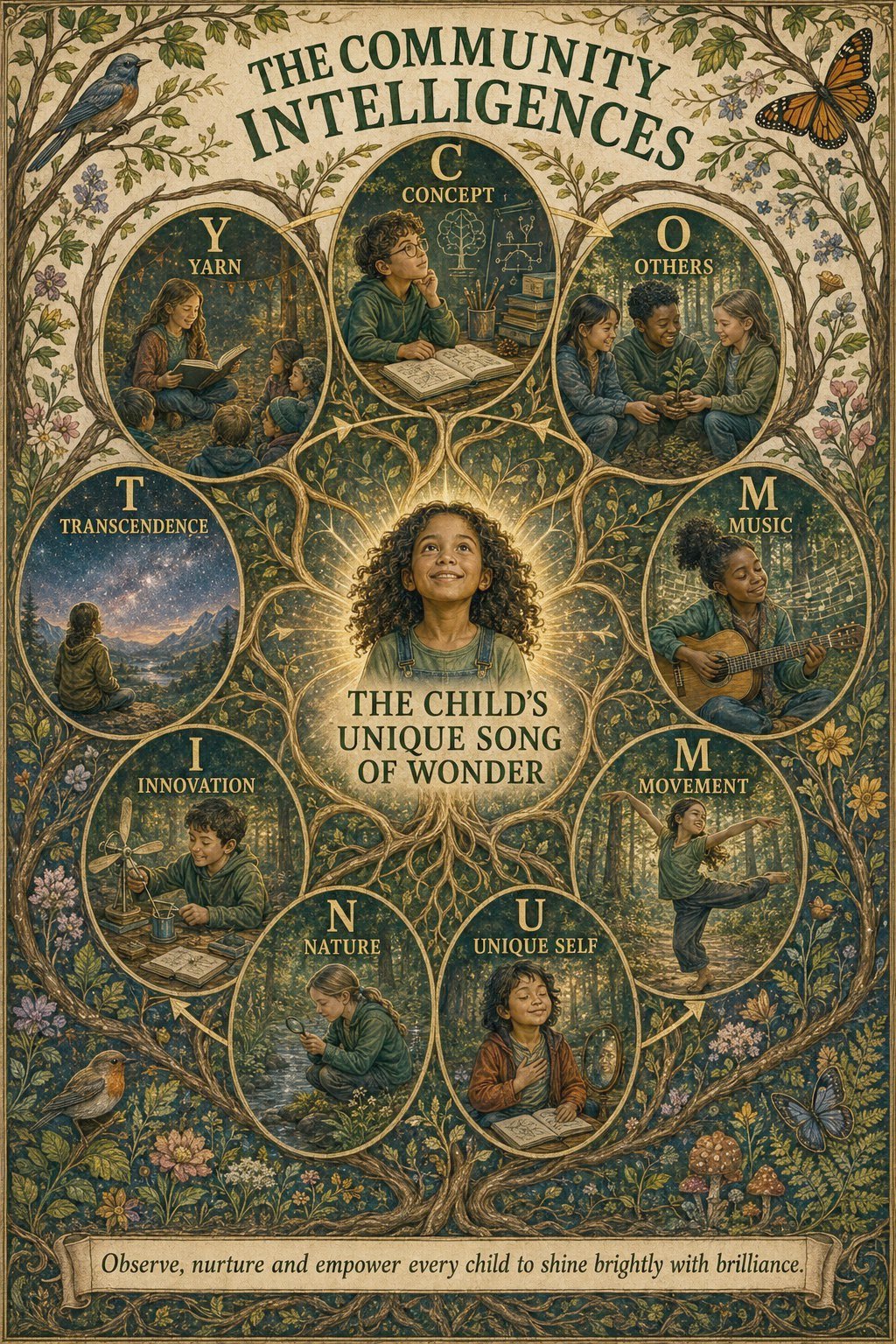
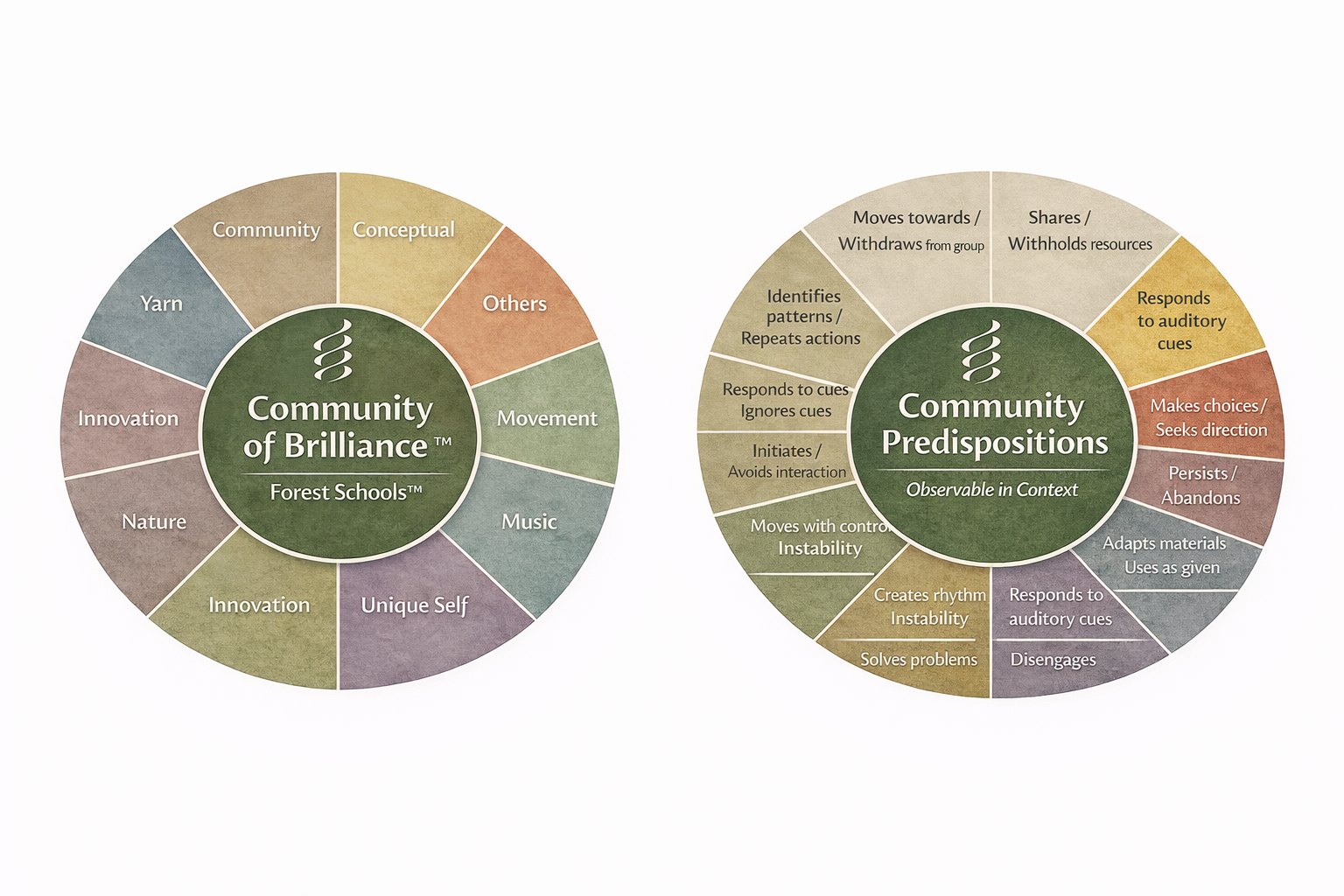
The nine intelligences, and the two halves of the model side by side.
Model 07
Community of Brilliance: the Attributes
Many strengths. One community. Limitless potential.
Nine attributes, observable in context. Everybody needs all nine. The intelligences say how a child is clever; the attributes are what a child uses to grow the one they are strong in, and to reach the ones they are not.
Gardner mapped the channels of intelligence but not the dispositions of heart and attitude that let them flourish. These draw on Reggio Emilia's dispositions for learning, the 5 C's and the 7 R's.
- Creativity
- Openness
- Mastery
- Mindfulness
- Unity
- Nurture
- Integrity
- Tenacity
- Yearning
Where it is taught. Level 3 alongside the intelligences, scored one to four from Not Yet Emerging through to Brilliance.
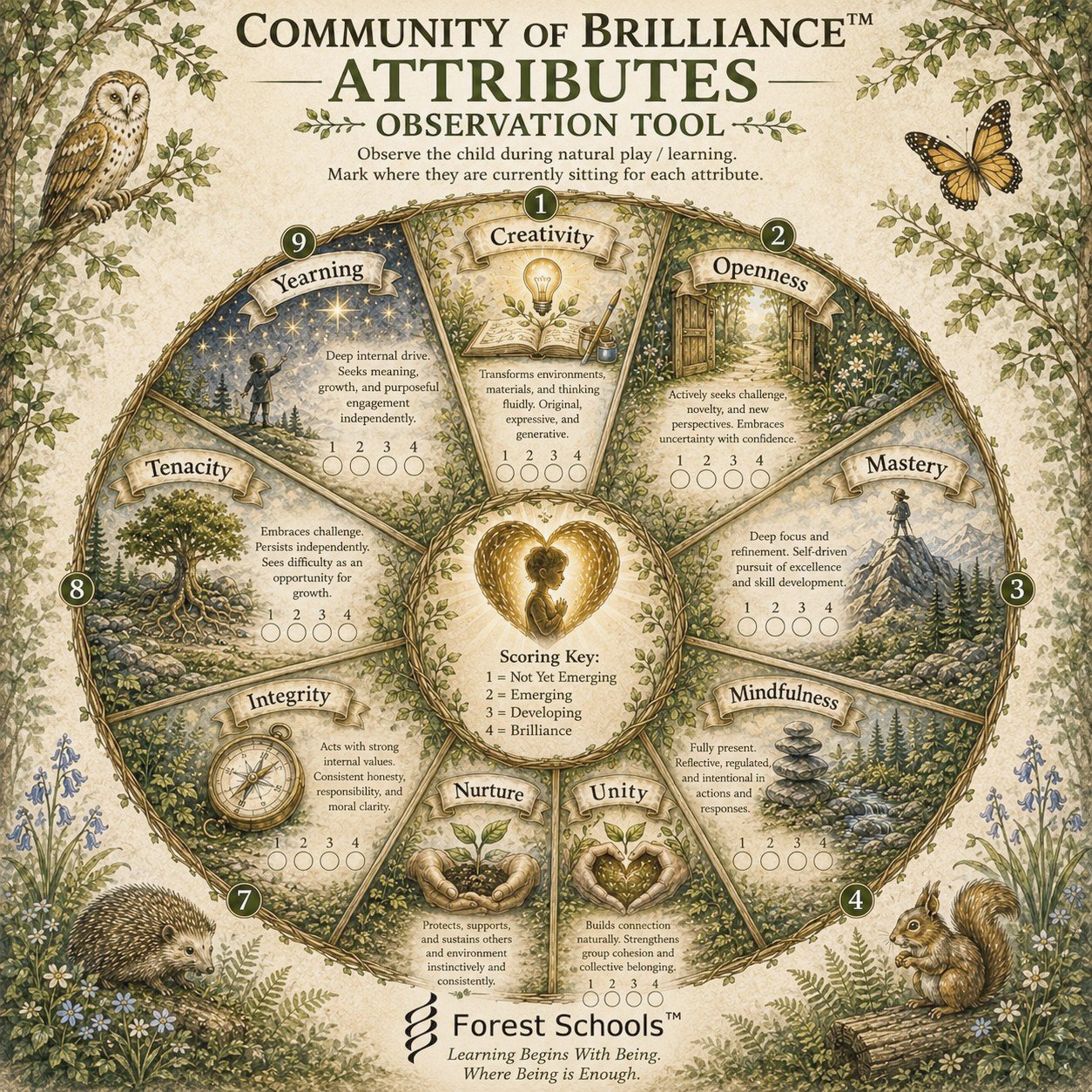
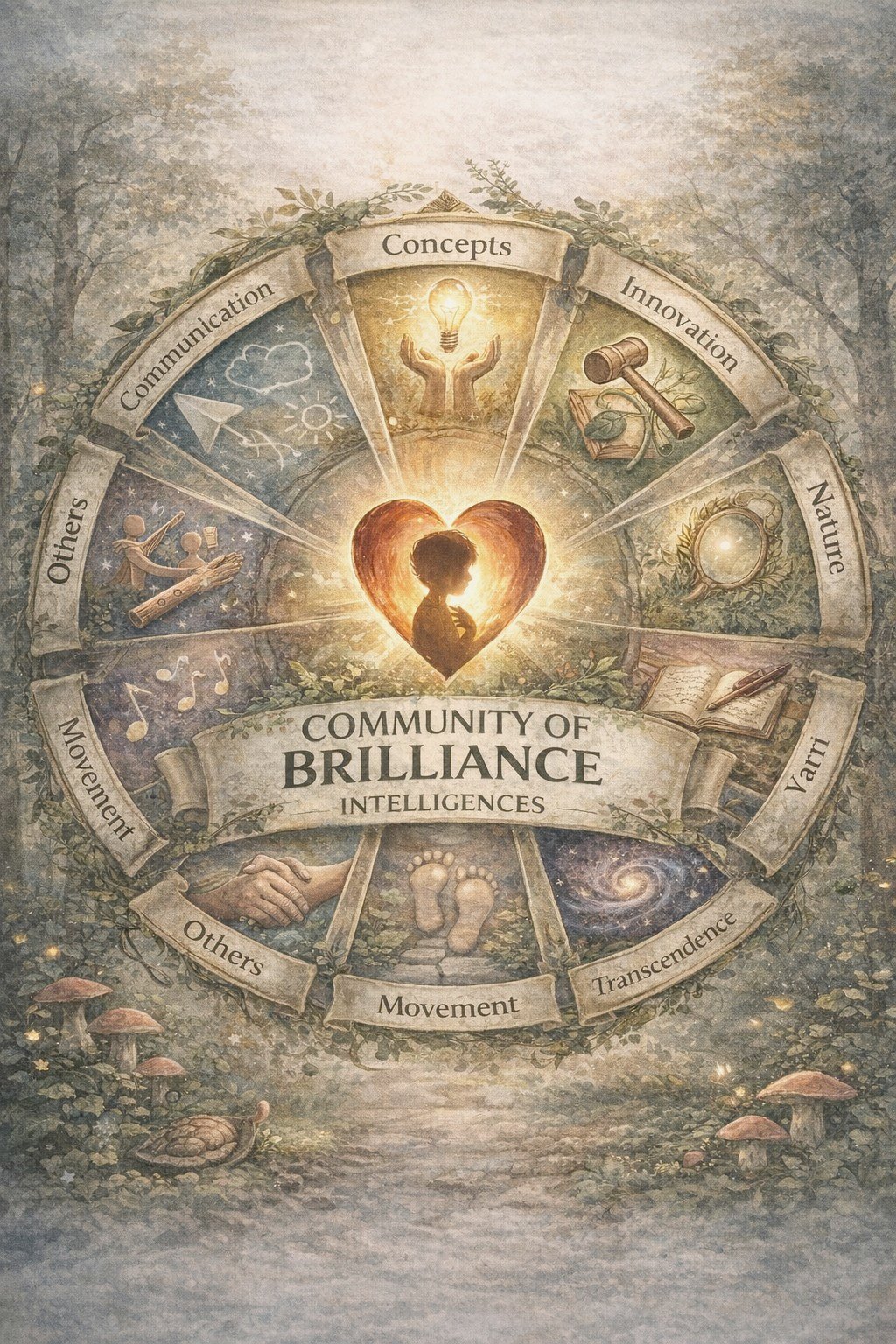
The attributes observation tool, and the two halves held in one wheel.
Model 08
The Biophilia Lexicon
Nature teaches the language through which humanity remembers how to belong.
Nine words that mean one thing in ecology and the same thing in a human life. The lexicon is how a practitioner explains why time outdoors is not a nice extra.
- Belonging
- Interconnection
- Origin
- Presence
- Harmony
- Identity
- Living Systems
- Integrity
- Attunement
Where it is taught. Level 3 as its own study, with a children's version used directly in session. Level 4 as the philosophical ground of the whole approach.
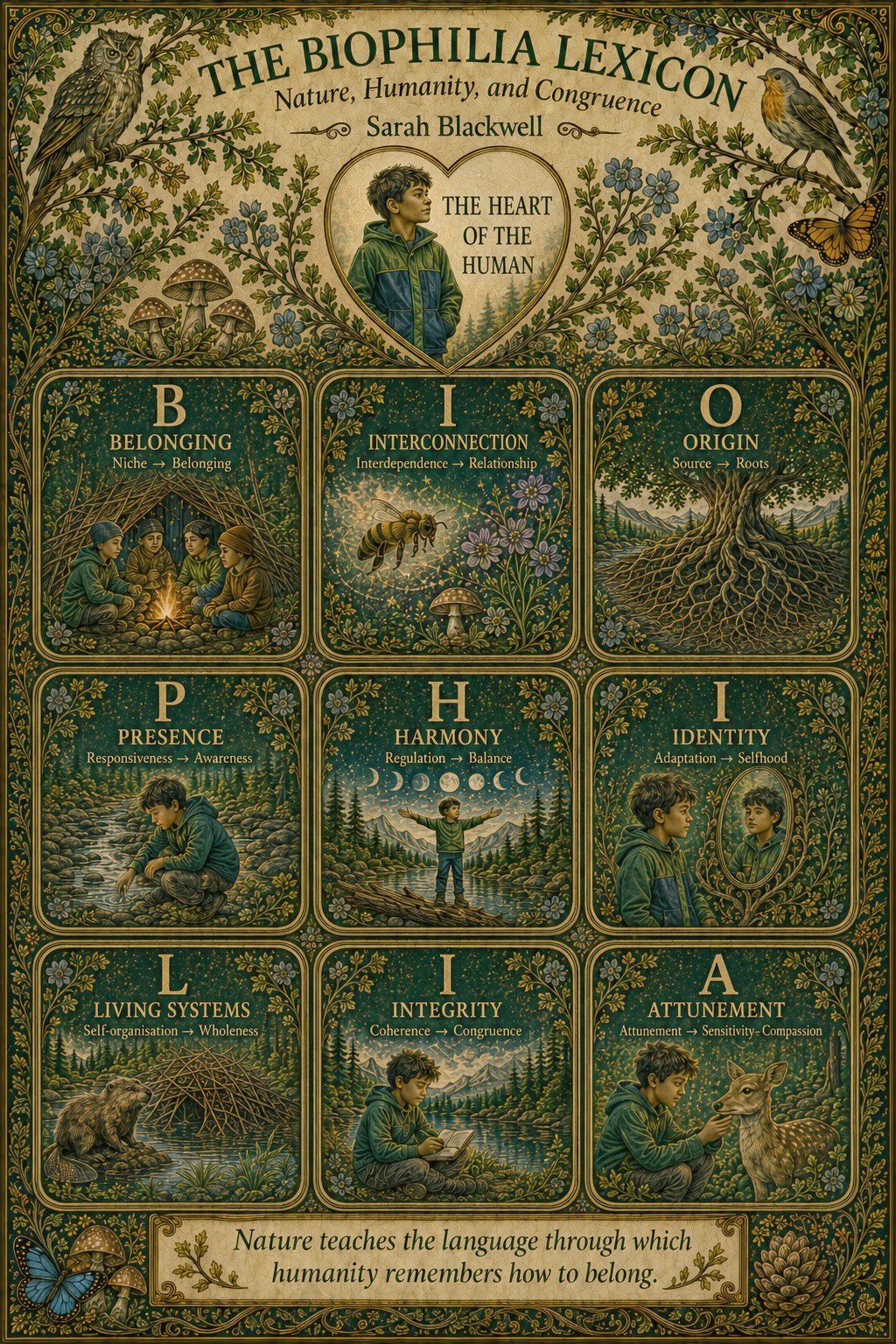
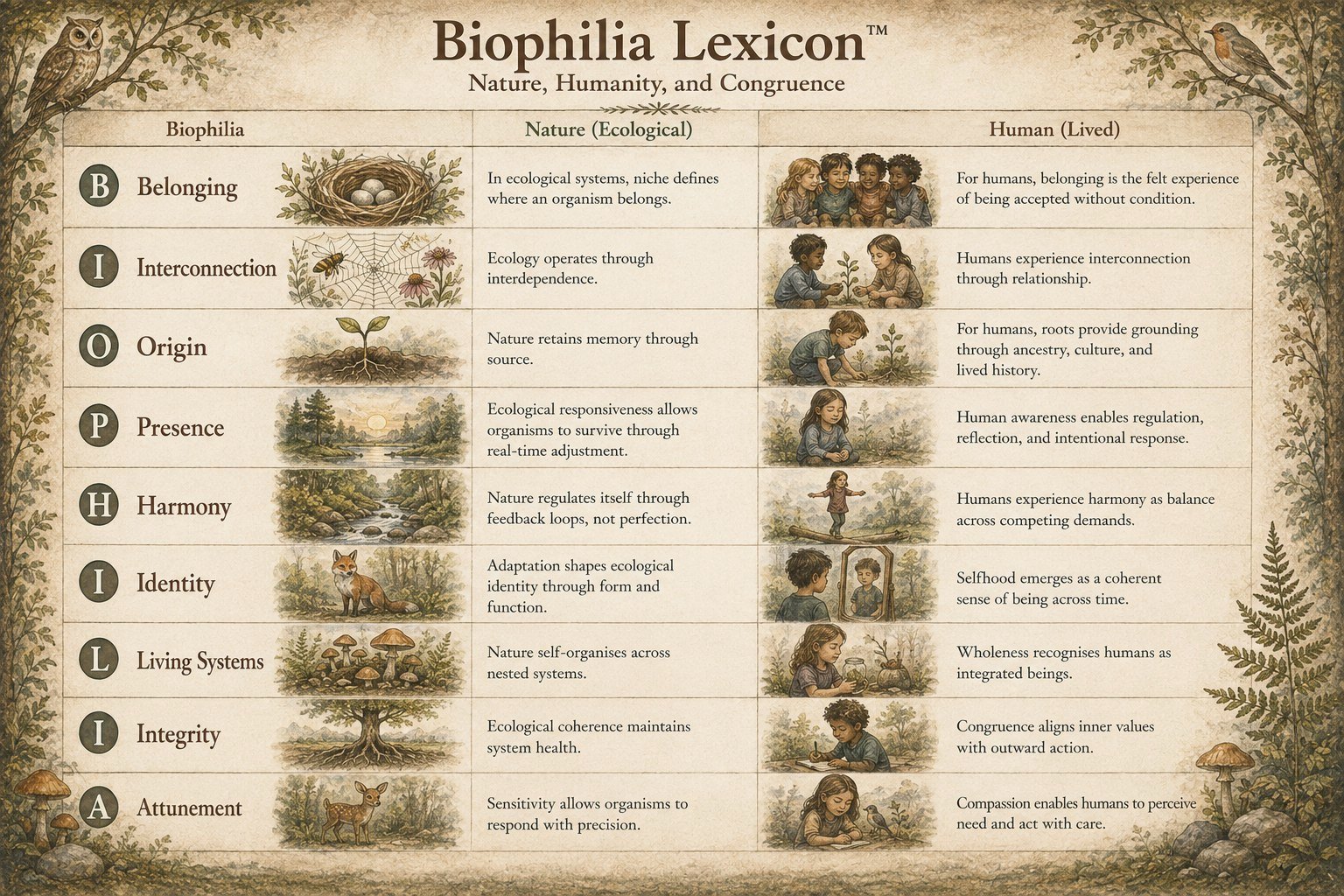
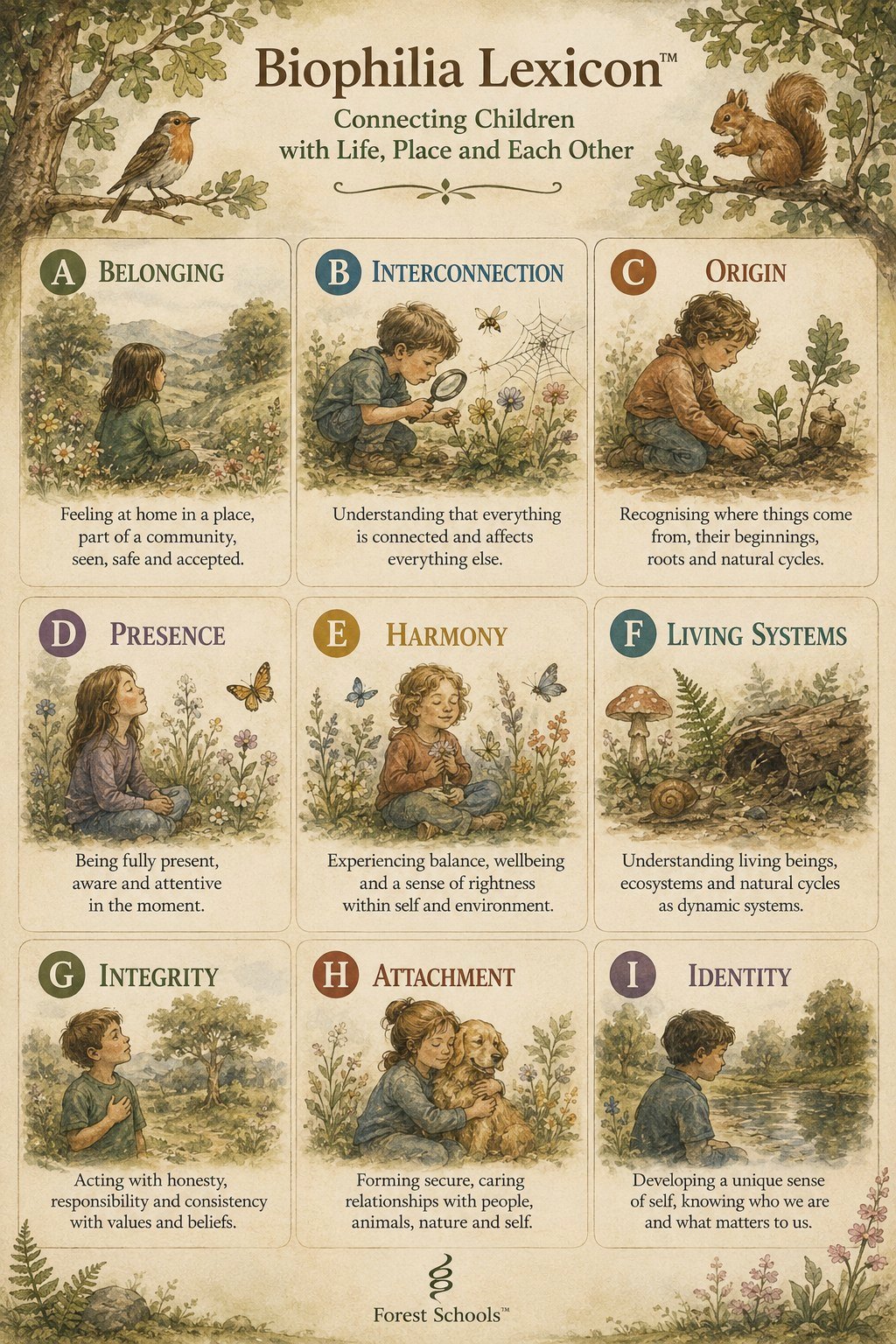
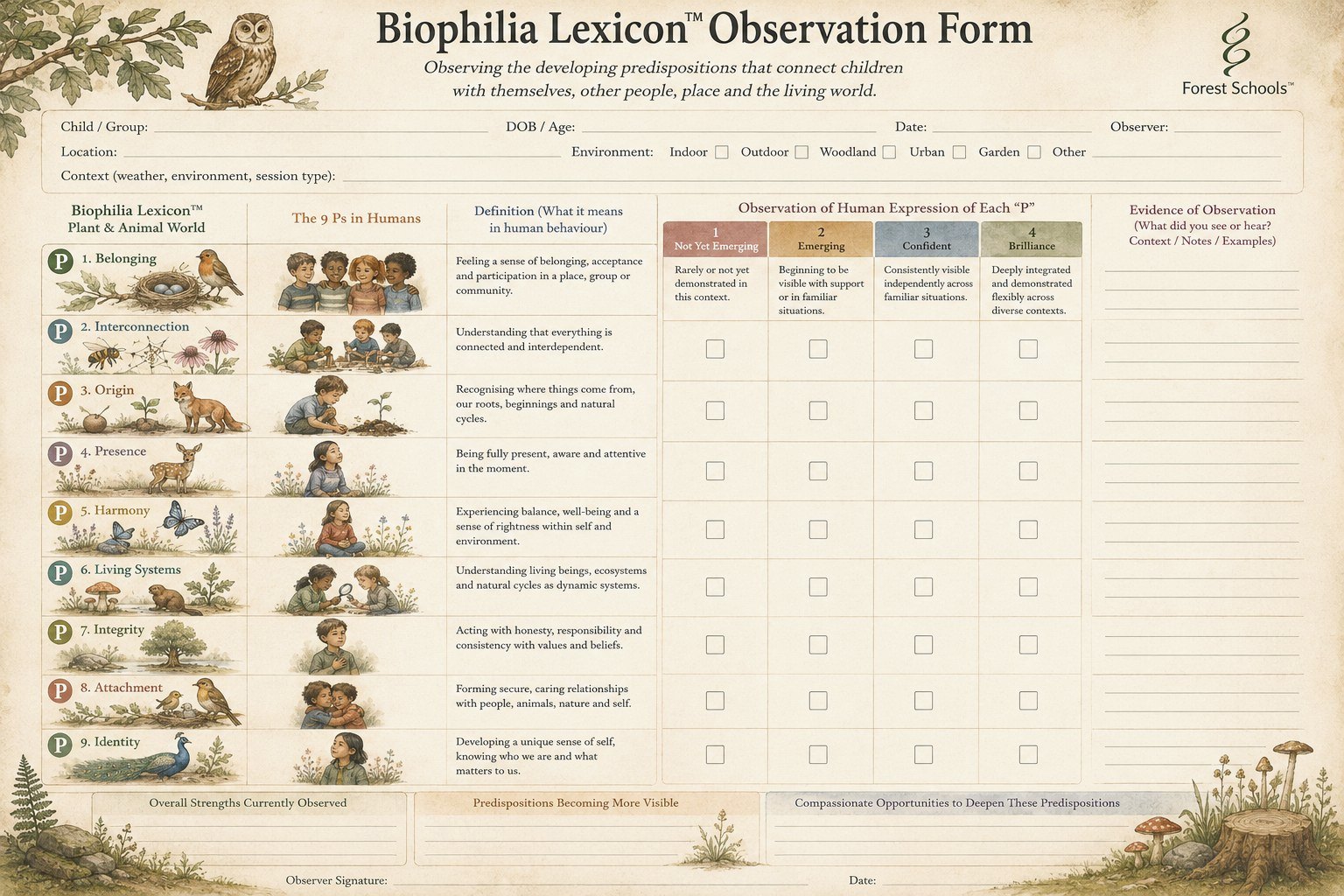
The lexicon, the ecological and human readings side by side, the children's version, and the observation form.
Model 09
The Senses as Gateways to Imagination
The senses connect us to the world. Creativity connects us to ourselves.
Rich sensory experience is not decoration. It is the raw material imagination is built from, and without it conceptual thinking has nothing to work with later on.
- Sight
- Sound
- Touch
- Smell
- Taste
- Movement and Vestibular
Where it is taught. Level 1 as the first thing a new practitioner learns to notice. Level 2 and Level 3 as the reason behind provision.
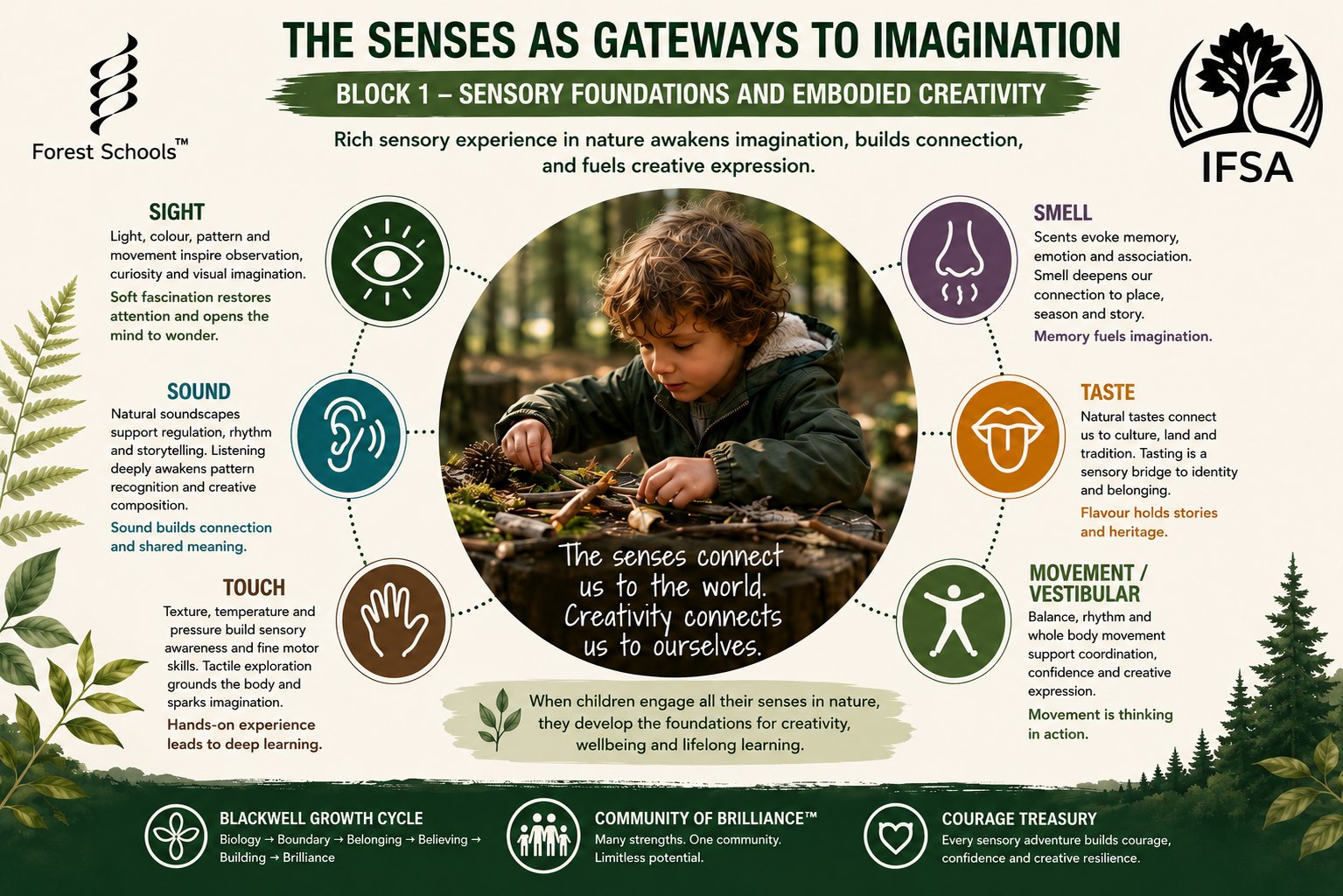
Movement is thinking in action. Flavour holds stories and heritage. Hands-on experience leads to deep learning.
Model 10
Holistic Development
Six domains. Never one at a time.
The map every other model reports into. A child climbing a tree is doing all six at once, and a practitioner trained to see all six can evidence far more from a single observation than one who was only watching the body.
- Physical
- Intellectual
- Language
- Emotional
- Social
- Spiritual
Where it is taught. Level 1 onwards, and it underpins the assessment criteria of the qualification itself. PILESS is not an Archimedes model. It is the established developmental map, and it is the frame the rest of this work is evidenced against.
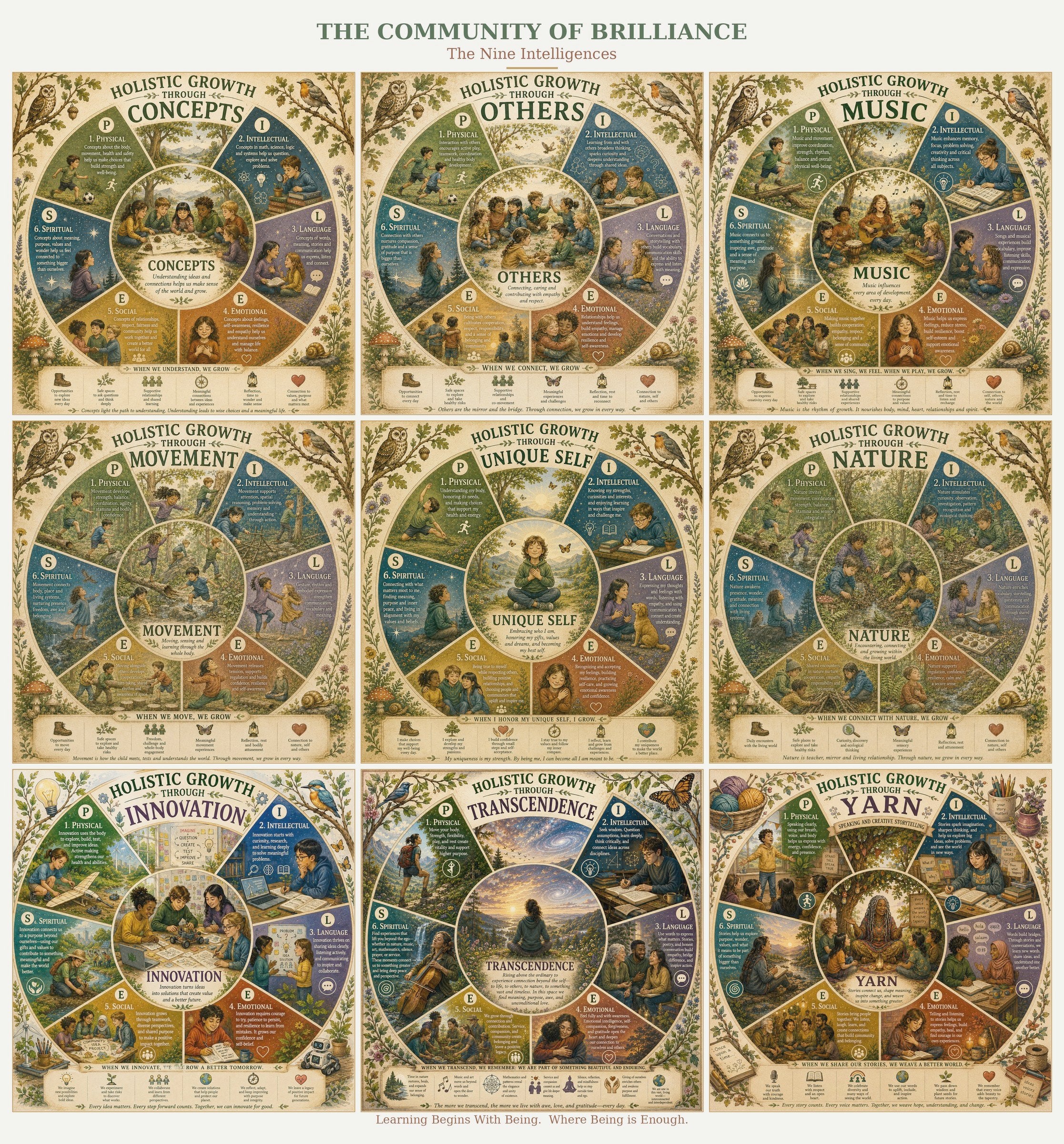
Nine wheels, one for each intelligence, each opened out across all six developmental domains. Holistic growth through concepts, others, music, movement, unique self, nature, innovation, transcendence and yarn.
How they work together
One child. Ten ways of looking.
A practitioner does not use nine forms in one afternoon. They learn to see through nine lenses and reach for the one the moment asks for. The Growth Cycle tells you where a child is. The schemas tell you what they are building. The P's tell you why to leave them alone. The C's and the R's tell you what they are becoming. The intelligences and attributes tell you who they already are. The lexicon and the senses tell you where all of it comes from. And all ten report into the same six domains, which is what the qualification actually asks you to evidence.
Learning begins with being. Where being is enough.
The Blackwell Growth Cycle, the CHOCOLATE Box Schema, the 7 P's of Play, the 5 C's Emotional Wealth Inventory, the Seven R Characteristics, the Community of Brilliance and the Biophilia Lexicon are the original work of Sarah Blackwell and Archimedes Forest Schools. The six domains of holistic development are not, and are used here as the established developmental map they are. They may be used freely by practitioners we have trained, in their own settings, with attribution. They may not be reproduced in commercial training by others.


