


What are Forest Schools? An Introduction.
Join thousands who've already started their Forest School journey
Forest School is a nature-based, learner-led approach to education delivered by trained practitioners in woodland settings. Through long-term programmes, it helps children and adults build confidence, resilience and a lasting connection with the natural world.
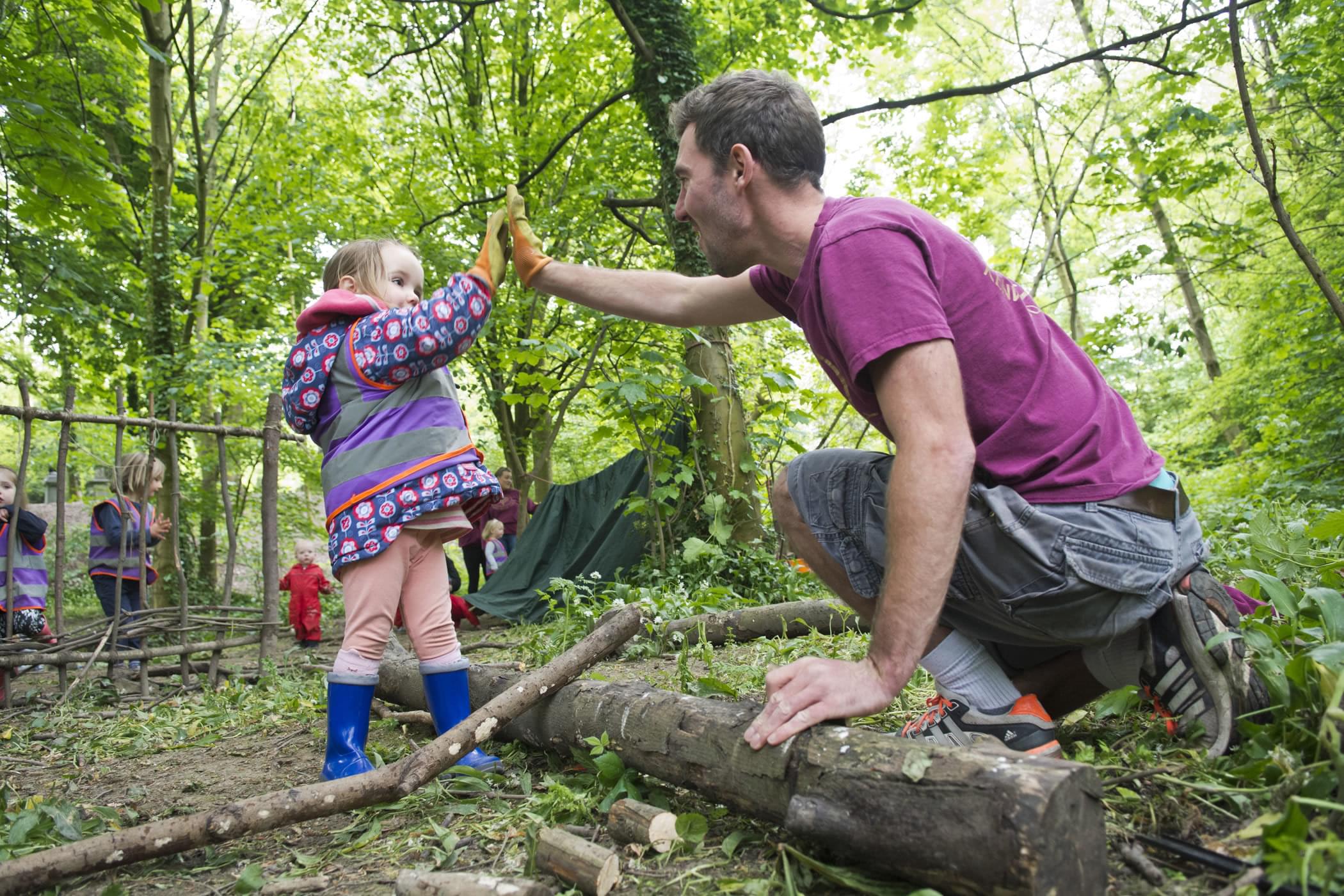
Wellbeing sits at the heart of what we do. By paying attention to the social, emotional and physical needs of every participant, our leaders create a space where people feel safe to explore, take appropriate risks, and grow at their own pace.
Sessions are shaped by the learners themselves. Leaders observe, mentor and gently guide, looking for natural opportunities to support holistic development over weeks and months rather than minutes and hours.
Over time, this builds a community grounded in collaboration and a willingness to embrace challenge. It is in this kind of community that character, empathy and resilience really begin to flourish.
Every session begins by checking in with how each person is feeling, before anything else.
The child sets the direction. Leaders offer ideas, but never impose them.
Real change happens over weeks and months, through trust, repetition and observation.
Take a look inside a UK Forest School
The six principles of quality Forest School
Quality Forest School in the UK is defined by six principles, agreed by the wider Forest School community in 2011. Every session at every accredited Forest School should hold to all six.
A long-term process
Regular sessions over an extended period, with planning, observation, adaptation and review built into every cycle.
A woodland or natural setting
Forest School takes place outdoors, ideally in woodland, to support a real relationship between the learner and the natural world.
Holistic development
Sessions support the whole person: social, emotional, physical, cognitive, communicative and spiritual development together.
Supported risk-taking
Learners are offered appropriate risk and challenge, with skilled leaders helping them assess and manage it themselves.
Qualified practitioners
Forest School is led by practitioners holding a minimum of an accredited Level 3 Forest School qualification.
A learner-centred approach
The programme is shaped by the interests of the learners, with leaders responding to what each session reveals.
What are the benefits of Forest School?
Forest School is more than time outdoors. The structure of the programme, the role of the leader, and the long-term nature of the sessions all combine to support real, measurable change.
- ConfidenceChildren find their voice and trust their own decisions.
- ResilienceLearning to stay with challenge, not avoid it.
- Physical wellbeingActive, outdoor sessions support strength and motor skills.
- EmpathyWorking as a group nurtures kindness and cooperation.
- Connection with natureA real, felt understanding of the woodland and its seasons.
- Learner-led growthChildren pursue what genuinely interests them.
- Mentoring over timeLeaders observe and guide across a long programme.
- Appropriate riskReal tools, real fires, real challenges, safely supported.
A typical day at Forest School

We meet at the edge of the woodland with a sense of anticipation. The birds are calling, a soft wind moves through the trees, and wellington boots are already searching out the nearest puddle.
From there, the day follows a gentle rhythm rather than a rigid plan. Here is how it usually unfolds.
Arriving and checking in
The site has been checked and the kit is ready. Before anything else, we gather as a group to see how everyone is feeling and to find out what each person would like to explore that day.
Exploring the woodland
The woodland itself becomes the classroom. It is full of textures, materials and small wonders that engage the senses and spark curiosity. Leaders may suggest ideas or new skills to try, but only as an offer.
Mentoring and challenge
As the session unfolds, the leader's role is to nurture, to encourage learners to stay with challenge, and to help them make sense of what they are experiencing. Appropriate risk-taking is welcomed and carefully supported.
Review and reflection
We close every session with a small ritual. Each person has a chance to share what they noticed, what they enjoyed, and how they felt. It is how we make sure every member of the community feels seen and valued.
Who we are
Sarah Blackwell
Sarah has been pioneering Forest Schools learning and training in the UK for over 25 years. She founded Forest Schools Education in 2000 and has gone on to train more than 25,000 practitioners across five continents. Her published work and academic research continue to shape the field today.
- Author, The Archimedes Forest Schools Model
- Published researcher, Sheffield Hallam
- Founder, Forest Schools Kindergarten
- 25+ years in the field
Frequently asked questions
What is Forest School?
Forest School is a long-term, learner-led approach to outdoor education. Run by qualified practitioners in a woodland or natural setting, it uses regular sessions over weeks and months to build confidence, resilience, and a lasting connection with the natural world.
What age is Forest School for?
Forest School is most often delivered to children in early years and primary settings, but the approach works for learners of any age, including teenagers, adults, and people with additional needs.
How long is a Forest School session?
A typical session lasts between two and three hours, but the defining feature is the long-term programme. Quality Forest School runs regularly, ideally weekly, over a sustained period of months or a full year so children experience the seasons.
What qualifications does a Forest School leader need?
A Forest School leader must hold an accredited Level 3 Forest School qualification. Level 1 is an introduction, Level 2 enables you to assist a leader, and Level 3 equips you to plan, run, and lead your own Forest School programme. See our learning pathways for the full route.
Where did Forest School come from?
Forest School draws on the Scandinavian tradition of friluftsliv, or open-air living. The approach was brought to the UK in the 1990s by educators who studied early years practice in Denmark, and has grown into a recognised pedagogy with thousands of trained practitioners worldwide.
Is Forest School part of the school curriculum?
Forest School is not part of the national curriculum but it complements it. Many schools run Forest School alongside classroom learning, and skilled leaders link the work to curriculum objectives in literacy, numeracy, science, and personal development.
Becoming a Forest School Leader
Modern education often pulls towards targets and outputs. Forest School offers something different. Our training gives you the knowledge, confidence and practical skills to put the child at the centre of everything you do, and to become part of the change you want to see.
Explore Leader TrainingTrainees often tell us the change is not only in the children. You learn to slow down, to observe more carefully, and to trust the process. We would love to welcome you to one of our programmes.


